

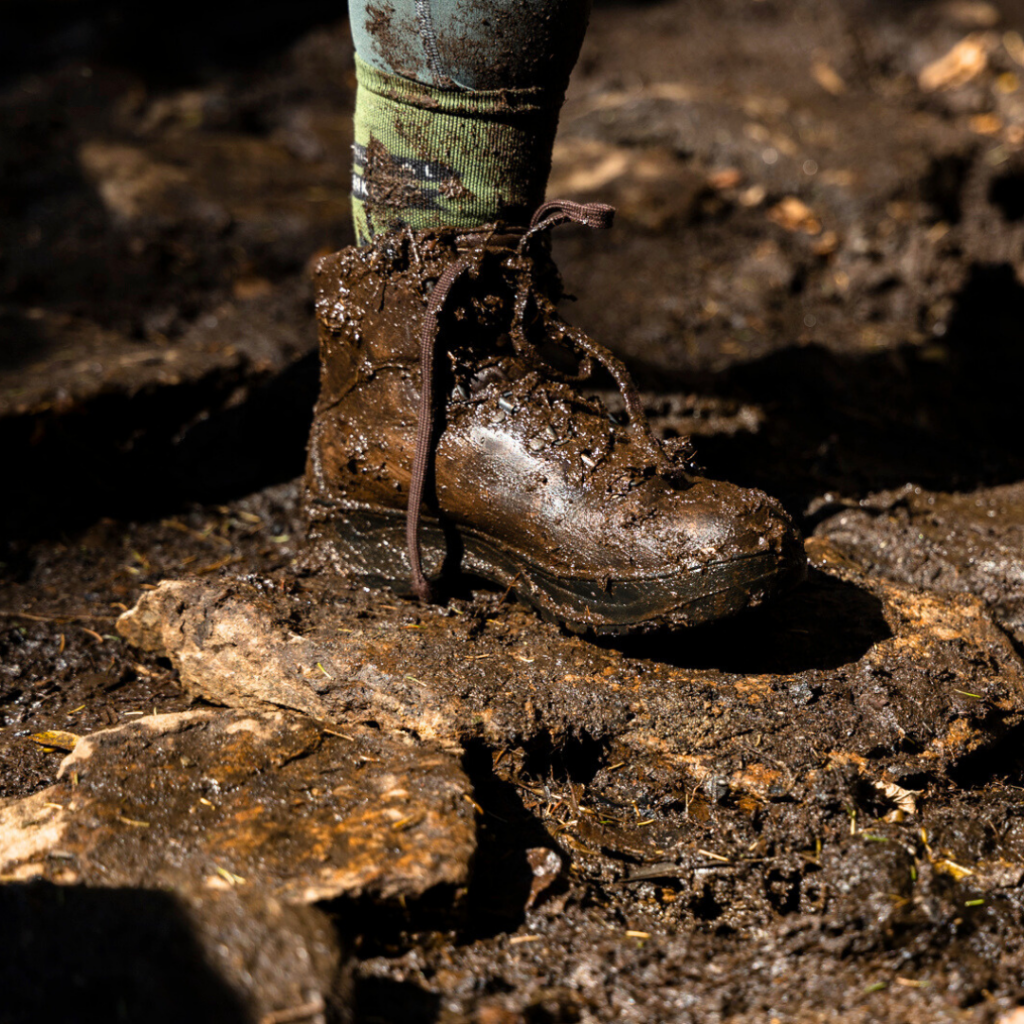
 If you’ve hiked on the Long Trail (LT), you’re probably familiar with some of its notorious mud pits that require wide, precarious steps over a few random logs that dot the surface of the mud puddle or sacrificing your mostly dry socks to tread directly through the ankle-deep sludge.
Mud management is part of the Green Mountain Club’s (GMC) trail work, and while we’d love to eliminate all mud on the Long Trail System, that’s a Sisyphean goal. Instead, we improve drainage where we can, install bridging or tread-hardening measures on perpetual mud pits, and try to educate the hiking public on how their approach to mud impacts the overall trail and landscape health.
So this mud season, learn more about the mechanics of mud and mud-abating measures on the trail, and why those DIY logs aren’t the solution you might think they are.
Why is Vermont Muddy?
Vermont is sometimes called “Vermud” by Appalachian Trail hikers, and GMC’s familiar refrain to stay off fragile, high-elevation trails during the spring mud season is well known. With impacts from climate change, mud season conditions are now possible in any month of the year.
What causes Vermont’s notorious mud and mud season?
- Vermont’s rocky soils have a higher percentage of clay minerals than surrounding states. Clay minerals absorb water and have very low permeability, preventing drainage.
- Soil still frozen from winter does not allow snowmelt and spring rains to percolate deeper, creating the saturated, messy top layer known as mud. High snow and cold winters like this one often result in longer, later mud seasons and a muddier hiking season overall.
- Soils at high elevations in Vermont are shallow and often on top of impermeable bedrock.
- Last but not least, much of the Long Trail System was built over a century ago, without the impacts of climate change and a fraction of the hikers we see today. Those trails were built either too steep or too flat, traveling through susceptible soils with poor drainage.
How GMC Manages Mud
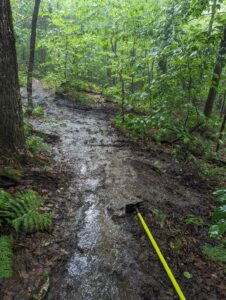 When assessing chronic mud pits, we look at where the water is coming from and any opportunity to exit the water . Preventing water from reaching the mud pit in the first place is the best option, and we can achieve this by installing drainage structures above it or relocating to a drier route.
Draining the mud pit, often through de-berming (removing the raised lip on the downslope side of the pit) or a drain, is the second-best option. If for some reason neither of those options are make sense, we consider a relocation or “harden” the trail, either via rock work or puncheon.
Relocation decisions are dependent on many factors, primarily length and severity of the mud pit and other trail layout issues, protected land corridors, and terrain options for a sustainable relocation. The recent southern terminus relocation is designed to move the trail up to a sidehill and alleviate some of the mud issues there.
Hardening the trail involves reconstructing the tread using features such as turnpikes or step stones, often combined with drainage improvements. These rockwork solutions are durable and effective, but they require significant time, cost, and skilled labor.
Puncheon: When it Works and When it Doesn’t
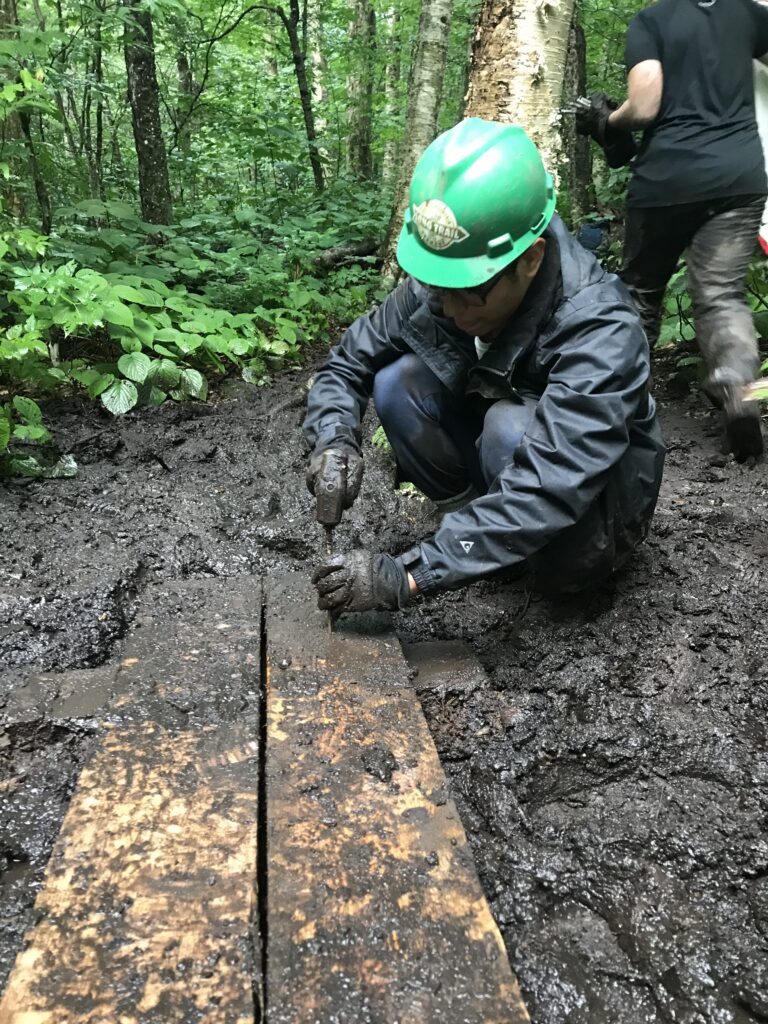
Puncheon is a common (and visible) solution to perpetually muddy areas, because compared to rockwork, it is quicker and easier to install. Puncheon in New England, sometimes referred to as bog bridging, typically adheres to this definition: “a single-or double-plank tread surface resting directly on mud sleepers, cribbing or piles.”
Most GMC puncheon is built out of Eastern Hemlock, which is fairly rot-resistant. We sometimes use more expensive, but more durable, black locust or cedar, or we fell trees f rom the surrounding area, usually red spruce or balsam fir, to create and install native puncheon.
GMC considers multiple factors when deciding if puncheon is the correct solution for a muddy piece of trail. Puncheon is fairly low-skill and fast to install, so GMC can work with volunteer service groups, section volunteers, or individual adopters to install puncheon. An efficient crew can build about 100 feet of puncheon in a day, and it starts working immediately.
But puncheon isn’t all sunshine and rainbows. The lumber is heavy and expensive, and packing it into the worksite is the biggest limiting factor. It also doesn’t last forever. Well-built puncheon ideally lasts 10-12 years, but that can vary, and the staff time and expenses add up over the decades.
Puncheon should only be installed in flat terrain, as sloped puncheon quickly becomes slippery and dangerous for the hiker. Trails that flood regularly are also not suitable candidates for puncheon as floodwaters can dislodge the boards. Ideally, puncheon begins and ends with durable tread, transporting the hiker across the muddy trail; placing 20 feet of puncheon in the center or at either end of a 100-foot mud pit doesn’t resolve the problem.
Good puncheon is sturdy with no bounce and no sag in the middle. GMC uses stringers that are 3”x8” and sills that are 6”x6”, so that puncheon is sturdy and settles in the ground. GMC uses a sledgehammer to drive galvanized 8” spikes through the stringers and into the sills. There should be a half-inch gap between stringers that allows water to drain but isn’t so large that a foot or trekking pole could get caught between them.
Why DIY Fixes Don’t Work
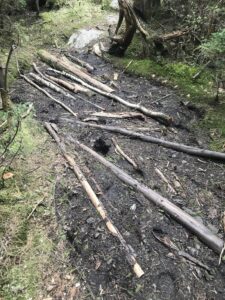
Hikers may see logs, bark, or brush added (usually by other hikers) to a mudpit to create a drier stepping surface. While it may be a very temporary fix, it can make the problem worse in the long run. Adding these items to the trail can dam up natural drainage in the pit, and that extra organic matter eventually decomposes and acts as a sponge, soaking up moisture and creating more mud in the long run. Rather than cobbling together a temporary fix, we kindly ask you to instead report the pit to GMC and walk right through the center of the pit to avoid widening it.
Despite GMC’s commitment to a durable and sustainable Long Trail System, it’s unlikely the club will resolve every mud pit on the 500-mile system — it’s just not practical or possible. So next time you come across a muddy stretch of trail, appreciate the heavy snowfalls, unique soils and ruggedness of the LT that created it in the first place. Look for a berm you can kick out to drain the pit, and traipse directly through the mud to avoid worsening the issue.
Help Us Manage Mud!
Vermont’s mud season generally runs from snowmelt to Memorial Day Weekend. High-elevation trails on state land are closed, and we ask for your cooperation in giving the saturated soils time to dry out by avoiding all high-elevation trails. Lower elevations, durable-surface trails, and dirt roads make great alternatives this time of year.
















Leave a Reply