

This article appears in the 2025 Summer Long Trail News as “Fighting Invasive Species on the Appalachian Trail: The Emerald Ash Borer Has Spread Throughout Vermont in Recent Years.” It was written by GMC Land Stewardship Coordinator Rowan Kamman.
Spend time in Vermont forests and you’ll encounter ash trees. These common trees have distinctive X-patterned corky bark, branches opposite each other on the trunk, and spearhead-shaped leaves. Three ash species grow in Vermont: green ash is sometimes planted along city streets. Black ash loves to get its feet wet in swampy areas, and is a traditional basket-weaving material, especially among the Abanaki. White ash abounds in hardwood forests, and is what hikers will see most often. Ash trees can grow very large by Northeastern standards: one in southern Vermont measures almost 44 inches in diameter!
Enjoy ash trees while you can, because sadly many will soon disappear. The emerald ash borer, an invasive wood-boring beetle native to Asia, is sweeping through the Northeast. It lays its eggs in ash bark, where the hatched larvae bore telltale S-shaped tunnels as they bore into the living tree tissue to feed, later emerging as adults. Infestations last for years, and are usually fatal for the afflicted trees.
First detected in northern Orange County in February 2018, the emerald ash borer has since spread to most of Vermont. Beetle larvae easily travel in transported wood, and probably that’s how the species arrived from overseas. This is why bringing firewood into the state is banned.
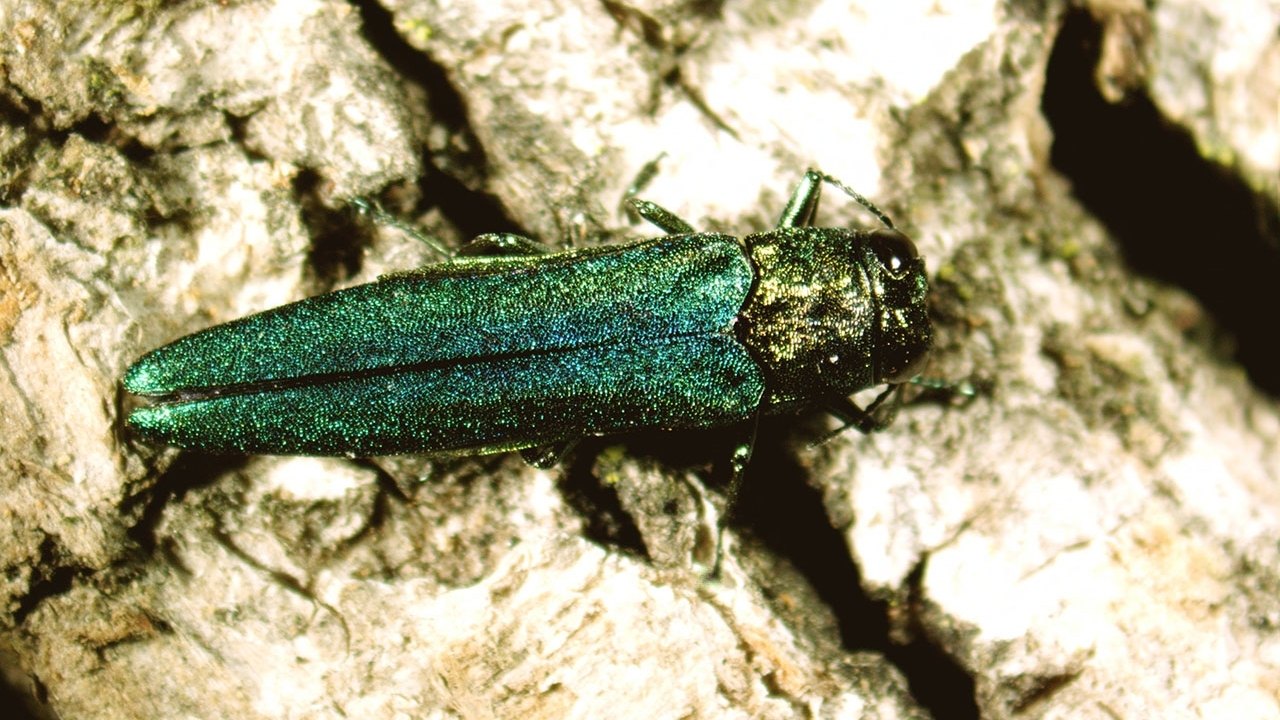
Adult beetles emerge in late May or early June, and are shiny emerald green, between 1/4 and 1/2 inch long. Signs of an infested tree are sinuous tracks under the bark, small D-shaped holes in the bark where the beetles emerged, and large swaths of bark removed by woodpeckers searching for larvae. Experts expect most of Vermont’s ash trees will die in the coming decades. Insecticide treatment works, but it is expensive and laborious, so many landowners choose to harvest ash instead of treating them.
However, the U.S. Forest Service (USFS) and the Appalachian Trail Conservancy (ATC) have decided on long term treatment of four stands of ash along the AT with insecticide. They are in West Hartford, in Pomfret near Thistle Hill and near Stage Road, and in Bennington south of Route 9, where the Appalachian Trail and the Long Trail coincide.
Dan Hale, ATC’s Senior Natural Resource and Land Stewardship Manager, says they chose these stands for their proximity to ecologically significant zone, and trail infrastructure like shelters. The treatment aims to both preserve ash tree genes for the future, and preserve biodiversity around the selected trees. Removal of a tree species can have adverse ecological effects in the surrounding area, especially on rare species and around vernal pools. So far, the treated stands include only white ash. But ATC would like to find suitable black ash candidates, and encourages hikers to report any black ash they find along the AT.
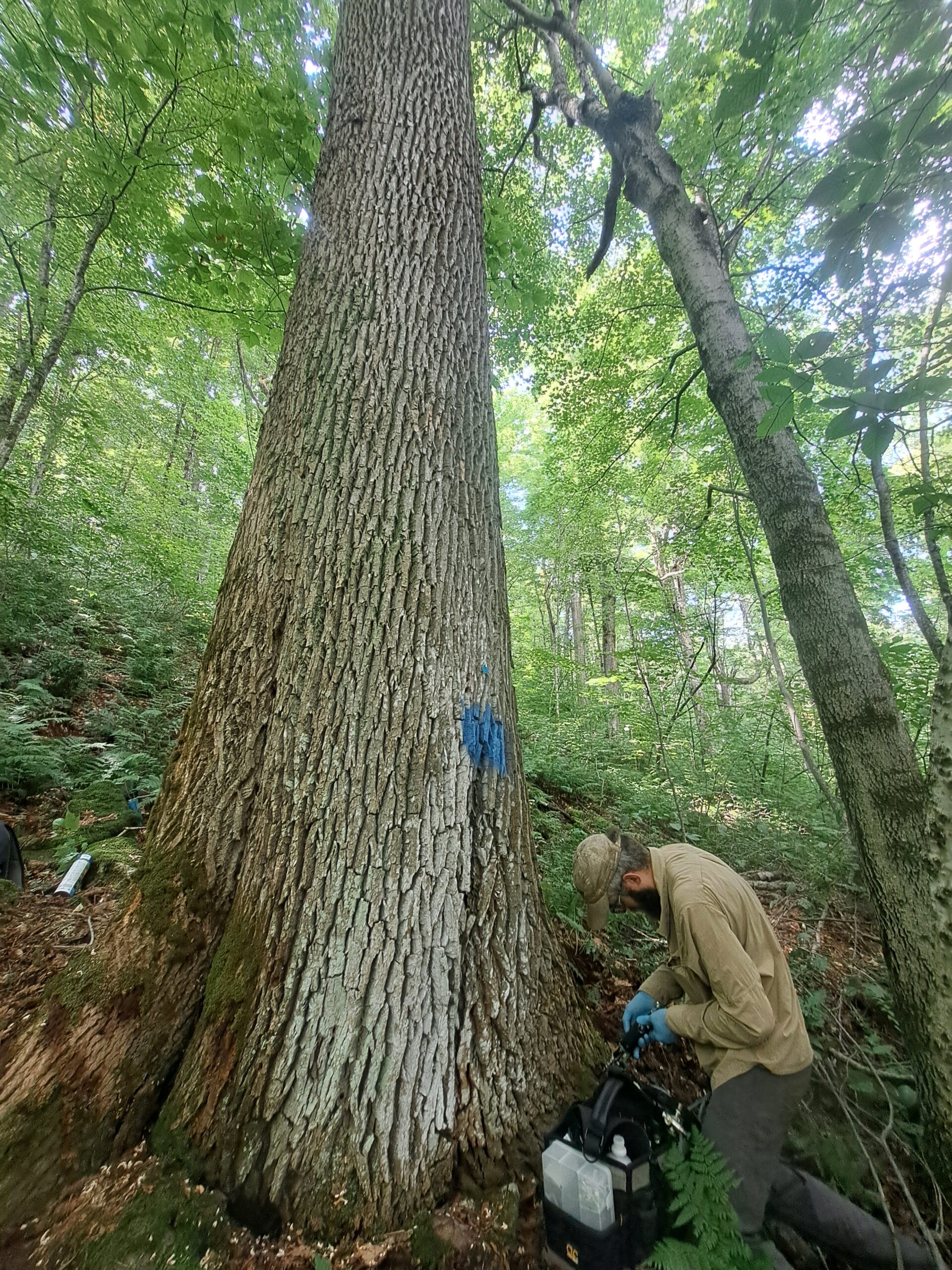
Ash treated by ATC is identifiable by blue paint markings and metal ID tags. Every three years, Forest Service and ATC staff inject insecticide into a series of holes drilled around the tree’s base. The insecticide, emamectin benzoate, is considered safe for pollinators, because it is contained in the trees’ tissues (also, ash trees don’t attract bees). Technicians insert an arbor plug in each hole, essentially a one-way valve that retains the insecticide.
Five milliliters of insecticide is injected per inch of tree diameter at breast height, with 10 milliliters injected per hole, rendering a tree toxic to emerald ash borer. The Forest Service and the ATC are encouraged by positive results that may allow lower doses in the next four-year cycle. Their efforts should help sustain these sylvan populations that could last indefinitely if other methods of controlling EAB are eventually developed.
Have you seen any black ash on the southern LT or AT in Vermont? Please tell Dan Hale by email at [email protected]
Rowan Kamman joined GMC in 2025 as the new Land Stewardship Coordinator. He brings experience from other Northeastern nonprofits focused on conservation, stewardship, and education. The Long Trail and the Green Mountains have been important to Rowan since he could fit in a backpack. He will coordinate GMC’s volunteer corridor monitoring program, which maintains the boundaries of conserved lands along the Long Trail and the Vermont Appalachian Trail.
















Leave a Reply