

A version of this article appeared in the Winter 2025 Long Trail News. This extended version also includes footnotes and sources.
 As a child on the family farm in Minnesota, I loved spending time in nature. But like many folks I know, I lost my connection to the outdoors as I grew up and took on a demanding legal career, working in New York City. But it was not sustainable for this country mouse, so after a decade I returned to Vermont (I previously attended law school here) and became a public servant working for the State of Vermont.
In 2024, I experienced burnout, a state of emotional and physical exhaustion brought on by chronic stress. My nervous system was stuck in sympathetic response, unable to return to a calm homeostasis caused by the activation of the parasympathetic nervous system. Something had to change, and it did in a big way: I took time away from work and spent more time being active outdoors. Hiking became my medicine, and slowly, I was able to heal.
Why did it work? Being active outdoors can provide numerous benefits to our physical and mental wellbeing. Many of us know this intrinsically, and feel better after a walk in the woods. But have you ever been curious about the science behind it? Here, we break down some of the research on the connection between the outdoors, the brain and social-emotional health.
The Biophilia Effect
The biophilia effect states that humans have a genetic tendency to affiliate with other forms of life and are drawn to experiences in nature1 in order to increase their physical, mental, and emotional wellbeing.
There are multiple benefits of just being in nature, which include2:
- Reduced anxiety and stress through soothing sounds, smells, and sights of nature;
- Improved mental health by reducing depression and anxiety, improving overall mood, and enhancing cognitive function;
- Increased creativity, productivity, concentration, and problem-solving skills;
- Faster healing and recovery.
Improve Brain Health
Cardio activity (hello, walking or hiking) increases respiration and blood flow to the brain, especially the prefrontal cortex – the part responsible for focus, decision-making, and memory. Brains operate at their optimum when the body is in a state of being both active and calm. The brain has very high metabolic demands — it accounts for at least 20% of the body’s overall energy consumption.3
Researchers at Stanford found that walking can boost creative thinking by up to 60%.4 Walking can literally promote both the growth and survival of brain cells, through the simulation of brain-derived neurotrophic factor, to enhance many of our cognitive functions and reduce risk of cognitive decline and dementia.
Walking can literally promote both the growth and survival of brain cells, through the simulation of brain-derived neurotrophic factor, to enhance many of our cognitive functions, such as: (1) Improved memory, attention, and problem-solving skills; (2) enhanced focus and concentration; and (3) better decision-making and reasoning abilities.5 Outdoor movement can also help create new brain cells, especially in the hippocampus, which is vital for memory.6 Additionally, regular movement outdoors helps to maintain your brain’s overall volume and prevent the deterioration of brain tissue over time, potentially reducing the risk of cognitive decline and conditions like dementia.7 Being active outdoors, including hiking, helps more than just our brains and cognition. Hiking is an amazing whole-body workout that strengthens our muscles, bones, balance, and our respiratory and cardiovascular systems.8
Reduce Stress and Anxiety
Movement has two powerful healing qualities: (1) it completes the stress cycle, telling our minds that we are safe and can shift into our parasympathetic nervous systems; and (2) it releases “feel-good” neurotransmitters like endorphins, serotonin, and dopamine, which directly reduce the levels of stress hormones, improve our overall mood, and promote a sense of well-being.9 Also, exposure to sunlight through your eyes and skin stimulates the creation of serotonin in your brain, a neurotransmitter that regulates our mood, enables feelings of social connection and contributes to a healthy self-image and confidence.
Try an Awe Walk
Adding an element of mindfulness to your movement powers up these healing benefits. Mindfulness is the awareness of being present and fully engaged with the present moment — free from distraction or judgment. To incorporate mindfulness there are 3 elements to bring you into the present moment: (1) choose what you put your attention on; (2) place your awareness in the present moment; and (3) simply observe and be curious about the small wonders unfolding all around you, instead of judging your experiences.
In a recent study, researchers coined this mindful moment outdoors an “awe walk.”10 “Awe is partly about focusing on the world outside of your head…and rediscovering that it is filled with marvelous things that are not you.” Feeling a sense of awe improves feelings of happiness and can increase your overall mood, as well as lessen negative emotions and decrease the overall amount of stress hormones in the body, which lead to body-wide inflammation.11
There is a reason why so many people feel a pull to being active in nature: we feel more positive and happier during and after these experiences. And only 5 minutes can be enough to increase your executive functioning, processing speed and working memory.12
Feeling a sense of awe improves feelings of happiness and can increase your overall mood. It can lessen negative emotions and decrease the overall amount of stress hormones in the body, which lead to body-wide inflammation. There is so much awe to behold all around Vermont; just get outside to experience it!
Find a Friend
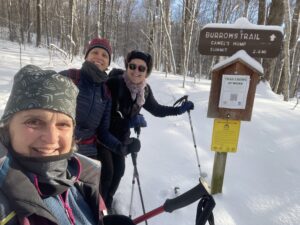
Another tremendous way to increase the benefits of hiking is doing it with another being, either human or pet. Being active outdoors with another person can enhance feelings of safety, which is calming to the nervous system. It also improves relational health and deepens social connections through shared experiences and memories. Being in company with others can also generate oxytocin, which reduces stress hormone levels.
There is a reason why so many people feel a pull to being active in nature: we feel more positive and happier during and after these experiences. As little as five minutes can be enough to increase your executive functioning, processing speed and working memory.
Join Me for a Hike and Restorative Yoga: January 3 and February 28, 2026
I have found that the key to my increased and sustainable wellbeing is to engage in activities that I enjoy with others. My body no longer craves the adrenaline and stress of mountain biking or trail running. Hiking is the perfect balance of both effort and effortlessness, so it doesn’t stress me out. To maximize the healing benefits of mindfulness, join me for a morning hike up Stowe Pinnacle followed by a Restorative Yoga class at the GMC Visitor Center. The hike is moderately challenging, but the yoga is ZERO effort, completely accessible to beginners. Essentially, you are guided into therapeutic poses supported by bolsters, blankets, straps, and blocks. The less you do, the more you gain because your nervous system shifts into the parasympathetic system where it can rest, digest, and heal.
Sign Up: January 3 Hiking and Yoga
Sign Up: February 28 Hiking and Yoga
Sources on Hiking and Mental Health
- One Small Step: The Mental Health Benefits of Walking Outside, Sara McCloskey (August 7, 2024).
- The Biophilia Effect: Exploring the Healing Power of Nature, book review by Devon Frye in Psychology Today (January 10, 2018).
- A Cellular Perspective on Brain Energy Metabolism and Functional Imaging, Pierre J. Magistretti, Igor Allaman, in Neuron Volume 86, Issue 4 (May 20, 2015).
- BDNF mediates improvement in cognitive performance after computerized cognitive training in healthy older adults, by Nicastri CM, McFeeley BM, Simon SS, Ledreux A, Håkansson K, Granholm AC, Mohammed AH, Daffner KR. Alzheimers Dement (N Y) (August 31, 2022)
- Can a Nature Walk Change Your Brain? Investigating Hippocampal Brain Plasticity After One Hour in a Forest, Sonja Sudimac, Simone Kuhn (December 1, 2024).
- Same as above.
- Benefits of Hiking, National Park Service (June 28, 2024)
- 5 Surprising Benefits of Walking, Harvard Health Publishing, Harvard Medical School (December 7, 2023).
- Burnout: The Secret to Unlocking the Stress Cycle, by Emily Nagoski PhD, Amelia Nagoski DMA (March 26, 2019).
- An ‘Awe Walk’ Might Do Wonders for Your Well-being, Gretchen Reynolds, New York Times (October 1, 2020).
- Same as above.
- Walking For Just 5 Minutes Does This Cool Thing to Your Brain, Per New Science, Korin Miller, in Women’s Health Magazine (June 3, 2025).
Samara Anderson is a lawyer and yoga teacher based in Ferrisburgh. She is a licensed attorney in Vermont and New York since 2003, and has been instructing yoga since 2013. Samara then started teaching mindfulness to stressed humans in 2016 to enable herself and others to lower stress hormone levels and continue practicing law (and being a human) in a more sustainable way. She section hiked the Long Trail from 2021-2023, and became a GMC outings leader in 2024. Samara’s yoga teachings are influenced by several yoga traditions, including: Ayurveda, Anusara, Hatha, Vinyasa, Yin, Restorative, and Kundalini.
















I love this article! Hiking and being in nature really do help mental health, and you explained it beautifully. This definitely inspires me to spend more time outdoors.