

This article first appeared in the Summer 2026 Long Trail News, titled “Field Notes: Season Preview 2026,” and was written by GMC’s Director of Field Programs, Keegan Tierney.
As trail crews finish their “mock hitch” training, and caretakers take their stations, the Green Mountain Club Field Program anticipates another busy season. It will focus on our trails’ long-term sustainability, paying increased attention to alpine stewardship; rebuilding flood-damaged infrastructure to withstand severe weather. We continue to plan large-scale projects to take advantage of one-time funds available for aging trails and overnight sites.
 Backcountry Stewardship and Caretakers
The caretaker program will have 15 positions, including two leaders, caring for high-use summits and ponds. We will run the Volunteer Trail Steward program for its second year, with trained volunteers helping caretakers meet and educate hikers at the Mount Mansfield Visitor Center, and adding the Lincoln Gap trailhead. We will also work with an intern from the University of Vermont to support alpine stewardship, interpretive education, and volunteer trail stewards.
We will finish the latest round of our alpine vegetation photo monitoring on Mount Mansfield. This project captures changes in alpine vegetation every five years to inform management of the mountain’s ridgeline.
Caretakers will make small improvements at various sites: install new composting toilets at Little Rock Pond Shelter and the Little Rock Pond Group Site, and repair the privy at Skyline Lodge. We will upgrade tent platforms and build new ones at Little Rock Pond, and repair the roof and porch at Skyline Lodge. The kiosk south of Middlebury Gap will be moved to accommodate the new trail alignment at the Middlebury College Snowbowl.
Major Projects
We will field two professional trail crews, one in the north and one in the south. Four senior trail technicians will do backcountry construction, and develop new construction methods. We are also hiring a volunteer support technician to continue building the skills, organization, and orientation of volunteers. Partnerships with the Vermont Youth Conservation Corps and, we hope, the National Civilian Conservation Corps, will supplement our work.
Much of our work this year will repair damage from the 2023 and 2024 floods, with funds from two sources: the Emergency Relief for Federally Owned Roads (ERFO) program for projects on the Appalachian Trail, and Federal Emergency Management Agency (FEMA) money directed through the Vermont Department of Forests, Parks and Recreation for work on state-owned land. We are implementing sustainable practices into all flood recovery work; namely building back bigger and more durable bridges and trail structures that can withstand future extreme weather events.
Season Work Plan, from South to North
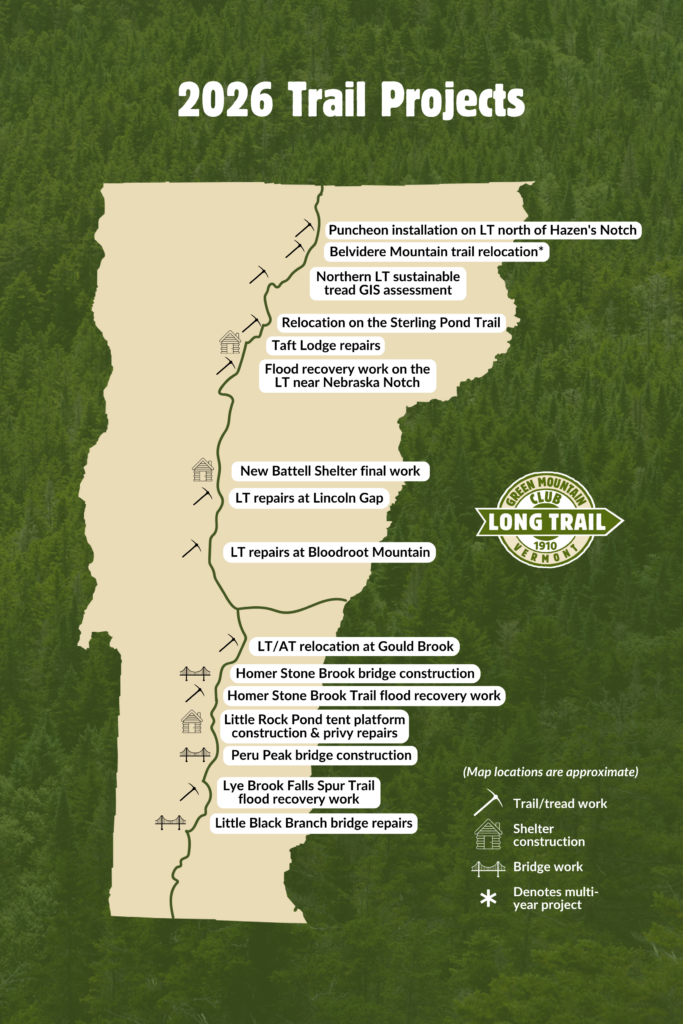
Continued reconstruction of the LT/AT north of Route 9, mostly stairs and retaining walls.
Relocation on the LT/AT north of Stage Road, begun in the 2024 field season by Greenagers, a Massachusetts youth corps. We will complete rebuilding a flood-damaged section of the Lye Brook Falls Trail, and senior trail technicians will replace a bridge over the Little Black Branch on the LT/AT south of the Kelley Stand Road.
GMC staff will also support and supervise the Vermont Youth Conservation Corps puncheon upgrading on the LT/AT between FR 10 and Little Rock Pond, to accommodate heavy hiker traffic and sensitive archeological sites. This work will be the first of three years on this stretch of trail, using ERFO and Legacy Restoration Funds (LRF) funds to improve portions of the trail washed out in multiple places by Little Black Branch.
Homer Stone Brook flooded in 2023, damaging the trail and a bridge. Crews will make major repairs to the Homer Stone Brook Trail. This will be another chance to test the efficacy of machine-built trails using our recently purchased mini-excavator on certain sections of trail.
Senior trail technicians will replace the bridge over Homer Stone Brook just north of Little Rock Pond. They will also replace a flood-damaged bridge just north of Peru Peak Shelter.
Additional tread repair is slated for the LT/AT in Shrewsbury, where repeated floods starting with Hurricane Irene have washed away the steep bank of Gould Brook to the trail’s edge; and tread repair to the LT north of Wetmore Gap.
Crews will begin to repair considerable damage along the LT north of Lincoln Gap, in the first season of a two-year project. In 2027 we will relocate the trail there to a more sustainable grade. Staff will also finish the Battell Shelter overnight site expansion.
On the northern LT we will raise a section of the LT at the Clara Bow Trail junction about 40 feet, removing it from the beaver pond complex; and we will make significant repairs to rotten logs at historic Taft Lodge.
Crews will complete a small relocation on the Sterling Pond Trail; continue work on the relocation of the LT on the south flank of Belvidere Mountain; and last, will finish a major native timber puncheon replacement project on the LT between Hazen’s Notch Camp and Domey’s Dome.
System wide, we will continue our sustainable trails assessment. Now that we have a baseline GIS model, the trail assessment specialist will hike the entire LT this season, writing field reports of trail conditions to record discrepancies with the online data and fine-tune the GIS-based model.
We expect the field season to be efficient and productive, with diverse projects, a highly skilled staff with several returning seasonal employees, and the application of sustainable trail building principles to everything we do. Thank you to our members and donors for supporting the Green Mountain Club, for making possible our trail and shelter projects from the smallest to the largest.
















Leave a Reply